

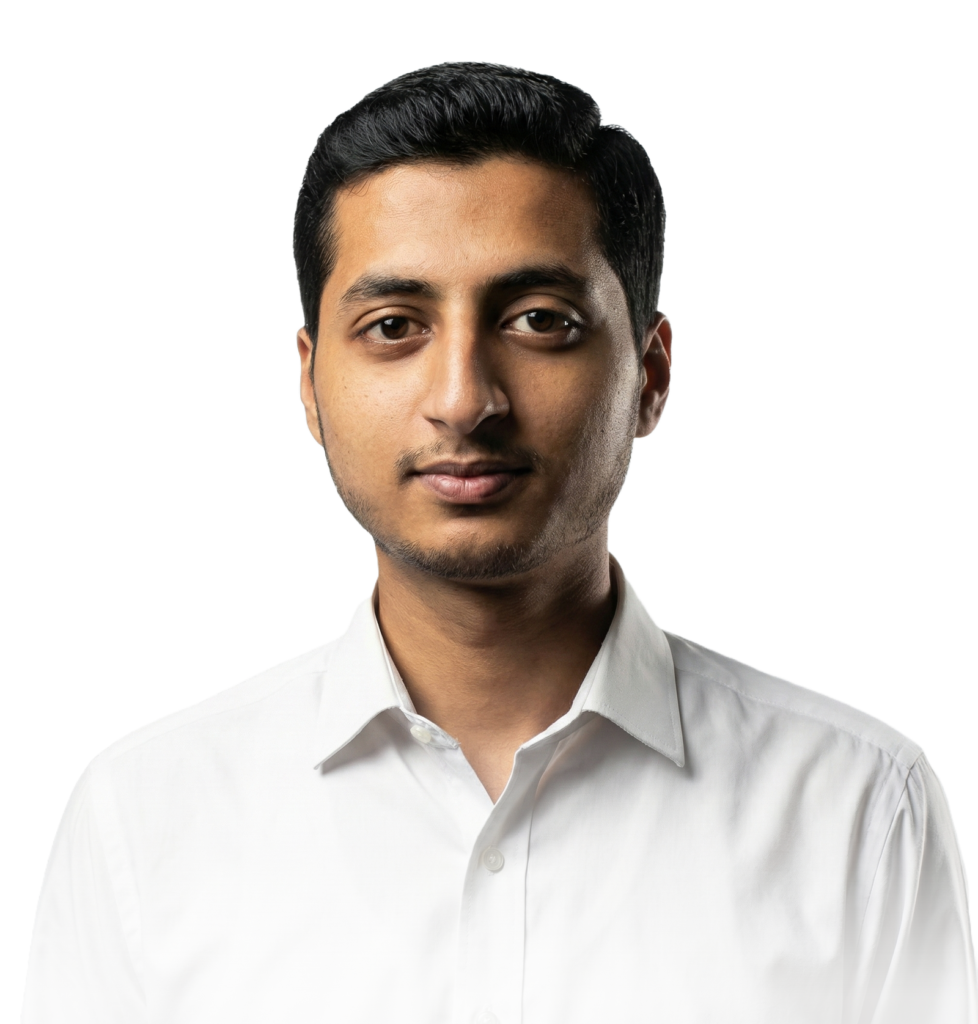
I’m Wishaq Akbar—an Artificial Intelligence graduate, creative technologist, and a student of systems, ideas, and human nature. I work at the intersection of intelligence, design, and purpose, building digital experiences that are not only functional, but meaningful.
For me, technology is not just a tool. It is a way to understand, shape, and influence the world.
I don’t see the world as random—I see it as a collection of systems.
And I believe that those who understand systems… eventually shape them.
This belief drives everything I do—from writing code to designing brands to studying society.
I build intelligent systems and digital identities.
Not just websites.
Not just models.
But complete structures that communicate, perform, and evolve.
I explore how machines learn, predict, and assist human decision-making.
My focus is on building AI systems that are practical, scalable, and purposeful.
I develop modern web applications using technologies like Next.js, TypeScript, and Tailwind CSS, focusing on performance, scalability, and clean architecture.
I design brands as systems of perception—where typography, color, and form work together to communicate identity and meaning.
Technical
Development
Creative
Beyond my professional work, I am deeply engaged in understanding:
I don’t study these as separate interests.
I see them as parts of a larger unified system of understanding reality.
My vision is long-term.
I aim to become someone who can design and influence systems at scale—
whether they are technological, intellectual, or societal.
I believe every system needs direction.
And every individual needs purpose.
Mine is simple:
To understand deeply.
To build intelligently.
To create impact that lasts.
Outside of direct work, I actively engage in:
I don’t chase trends.
I try to understand why trends exist.
I don’t just build products.
I try to understand what makes them matter.
And I don’t just learn skills.
I try to understand how everything connects.
I’m not just building a career.
I’m building a direction.
A direction where intelligence, design, and purpose come together—
to create something bigger than just projects.
Al-Sadiq Model High School
Riphah International College
The University of Faisalabad
Conversational
Native
Intermediate
Upper Intermediate
Neurazix - Full Time
Upwork - Full Time
MIK Web Solutions - Part Time
The Timali Group - Part Time
DVRP Ecom - Part Time
Fiver - Full Time
This paper proposes a compact self-isolated quad-port CPW-fed UWB-MIMO antenna with ML-assisted optimization for IoMT wearable healthcare.
This paper proposes a compact deep-tissue optimized implantable antenna for reliable biomedical telemetry applications.
This paper proposes a miniaturized dual-band implantable antenna for deep-tissue IoT-enabled biomedical monitoring and biotelemetry.
This paper proposes a deep-tissue optimized implantable antenna for reliable biomedical telemetry applications.
I’m Wishaq Akbar — an AI enthusiast, creative technologist, researcher, and lifelong student of intelligence, ideas, and human nature.
I explore the relationship between Artificial Intelligence and Natural Intelligence: how humans think, learn, reason, believe, create, and make sense of reality — and what these things can teach us about building intelligent machines.
My work sits at the intersection of AI, technology, design, philosophy, religion, and research.
I don’t see these as isolated disciplines. To me, they are different ways of asking the same fundamental questions:
I believe that before we try to create intelligence, we should first try to understand it.
Artificial Intelligence gives us a new way to examine questions that humans have been asking for centuries:
This is why my interest in AI extends beyond models, algorithms, and software.
I’m interested in the ideas behind intelligence.
I study human thought, philosophy, religion, history, science, and technology because each offers a different perspective on the same larger problem: understanding intelligence and reality.
My professional work is where these ideas become tangible.
I build AI systems, digital products, and visual identities that solve problems and communicate ideas.
I explore and build practical AI systems that can reason, automate, assist, analyze, and create.
My interests include machine learning, intelligent agents, automation, and the broader question of how AI can extend human capability.
I’m particularly interested in moving beyond simply using AI toward understanding what intelligent systems can become.
I build modern digital experiences and applications using technologies such as Next.js, TypeScript, Python, and Tailwind CSS.
For me, development is more than writing code. It is the process of turning an idea into a functioning system.
I care about clarity, architecture, performance, and purpose—not simply making something work, but understanding why it should exist and how it should evolve.
My curiosity extends far beyond technology.
I’m particularly interested in subjects that help answer fundamental questions about human beings, knowledge, society, and reality.
How do humans perceive, learn, reason, remember, imagine, and make decisions?
Understanding natural intelligence gives us a foundation for thinking about artificial intelligence.
Philosophy provides a framework for questioning the assumptions behind what we know.
I’m interested in questions surrounding knowledge, consciousness, reason, existence, ethics, meaning, and reality.
Religion offers another dimension to the study of humanity: questions of purpose, morality, existence, revelation, and the nature of human life.
I am particularly interested in exploring Islamic intellectual thought and its perspectives on knowledge, reason, humanity, and purpose.
Civilizations are systems built by human beings.
Studying how civilizations emerge, develop, interact, and decline helps reveal recurring patterns in power, knowledge, culture, technology, and belief.
Science gives us methods for investigating reality, while technology allows us to transform what we discover into practical systems.
I’m interested in the space between the two—where knowledge becomes capability.
I try to approach everything through questions rather than assumptions.
I don’t want to simply know what something is.
I want to understand:
This way of thinking influences both my research and my work.
When I design something, I think about the system behind the design.
When I build software, I think about the problem behind the software.
When I study AI, I think about the intelligence behind the algorithms.
And when I study humanity, I look for the connections between ideas, people, systems, and history.
My curiosity is not purely theoretical.
I want to build.
The things I study eventually become questions about what can be created:
These questions motivate the practical side of my work.
I see research, philosophy, technology, and design as a continuous cycle:
Question → Understand → Explore → Build → Learn → Question Again
I’m still learning, and that is intentional.
I don’t want to define myself only by a job title or a fixed list of technologies.
My direction is toward becoming someone capable of understanding complex systems and creating meaningful ones.
That may mean an AI model.
A research project.
A digital product.
A new way of presenting an idea.
Or simply a better question.
The common thread is intelligence—understanding it, extending it, and exploring what it makes possible.
I believe knowledge becomes valuable when it changes the way we see and act.
My purpose is therefore not simply to accumulate information or build technology for its own sake.
It is to:
And wherever possible, turn that understanding into something that can be useful to others.
Outside of building and research, I spend much of my time exploring ideas.
I enjoy:
I’m naturally drawn toward questions that don’t have simple answers.
Because sometimes the value isn’t in finding the answer immediately.
It is in learning how to ask the right question.
I don’t have every answer.
And I don’t think I need to.
What I have is a direction.
A direction toward understanding intelligence, humanity, technology, and purpose—and exploring what happens when these ideas meet.
I want to continue researching, building, questioning, and creating at that intersection.
Because the future of Artificial Intelligence may ultimately teach us something much deeper than how machines think.
It may force us to understand ourselves better.
That is the direction I’m following.
From natural intelligence to artificial intelligence.
From ideas to systems.
From curiosity to creation.