

Problem Statement
Designing and optimizing an antenna typically requires repeated electromagnetic simulations to understand how changes in its geometry affect performance.
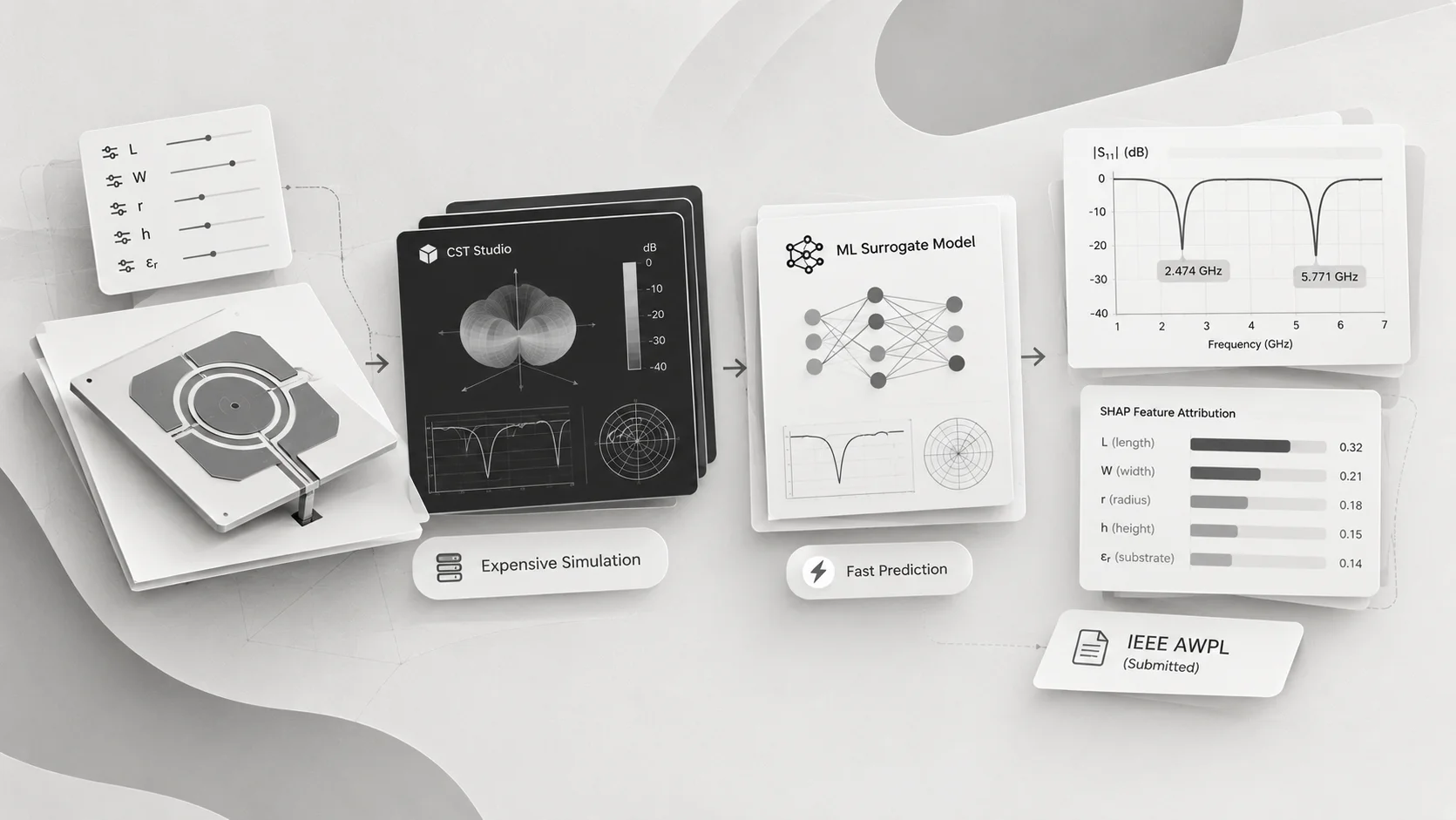
For a dual-band circularly polarized antenna, parameters such as geometric dimensions must be varied and evaluated repeatedly in CST Studio to identify configurations that produce the desired resonant frequencies and electromagnetic characteristics. Each simulation can be computationally expensive, making large parametric sweeps time-consuming and limiting how many design configurations can practically be explored.
This creates a bottleneck in the antenna-design process: the more thoroughly the design space is explored, the greater the computational cost becomes.
The challenge was therefore to determine whether machine learning could learn the relationship between the antenna’s design parameters and its electromagnetic simulation outputs, providing a fast approximation that could reduce the need to repeatedly run full CST simulations.
Proposed Solution
A machine-learning-based surrogate model was developed to approximate the electromagnetic behavior of the antenna.
Instead of running a complete CST simulation for every new combination of design parameters, the model learns from previously generated simulation data. Once trained, it can predict the corresponding antenna response much more quickly, providing an efficient approximation of the computationally expensive simulation process.
The workflow connects the two domains:
Antenna Geometry → CST Electromagnetic Simulation → Training Data → Regression Model → Predicted Response
The model was evaluated against the original simulation results, with particular attention to the antenna’s baseline resonances at 2.474 GHz and 5.771 GHz.
Interpreting the Model
To make the learned relationship more understandable, SHAP-based feature attribution was applied. This helped identify which antenna design parameters contributed most strongly to the model’s predictions, providing insight into the relationship between geometry and electromagnetic behavior rather than treating the model as a complete black box.
Research Outcome
The work demonstrates how a learned surrogate can be used as a computationally efficient approximation of electromagnetic simulation, potentially making parametric exploration and antenna optimization more practical.
The findings were also co-authored for submission to the IEEE Antennas and Wireless Propagation Letters (AWPL).